
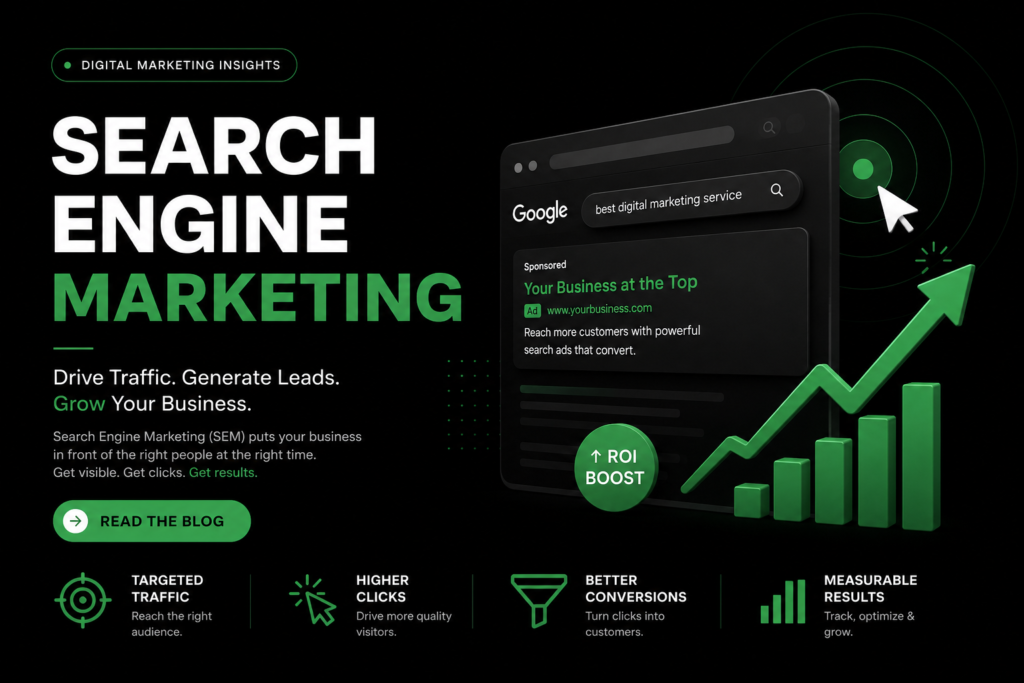
What is Search Engine Marketing (SEM)?
Search Engine Marketing (SEM) is a digital marketing strategy that helps businesses increase their visibility on search engines through paid advertisements. When users search for products or services related to your business, SEM allows your ads to appear at the top of search engine results, helping you attract potential customers instantly.
Unlike Search Engine Optimization (SEO), which focuses on organic rankings, SEM delivers immediate visibility through paid campaigns, making it one of the fastest ways to generate qualified traffic and conversions.
Why Search Engine Marketing Matters
Millions of people use search engines every day to find products, services, and solutions. If your business isn’t visible when customers are searching, you’re likely missing valuable opportunities.
Search Engine Marketing helps businesses:
- Reach customers who are actively searching for their products or services
- Increase website traffic instantly
- Generate qualified leads
- Improve online sales
- Build brand awareness
- Achieve measurable marketing results
- Compete with larger businesses effectively
SEM targets users based on their search intent, making it one of the highest-converting digital marketing channels.
How Search Engine Marketing Works
SEM operates on a Pay-Per-Click (PPC) advertising model. Advertisers bid on keywords that are relevant to their business. When someone searches for those keywords, search engines determine which ads appear based on factors such as:
- Keyword relevance
- Bid amount
- Ad quality
- Landing page experience
- Expected click-through rate
You only pay when someone clicks on your advertisement, making SEM a cost-effective marketing strategy when campaigns are properly optimized.
Key Components of SEM
Keyword Research
Successful SEM campaigns begin with choosing the right keywords. These should closely match what your target audience is searching for.
Effective keyword research focuses on:
- High-intent keywords
- Long-tail keywords
- Local search terms
- Commercial intent searches
- Negative keywords to avoid irrelevant clicks
Compelling Ad Copy
Your advertisement should grab attention while encouraging users to click.
A strong SEM ad includes:
- An attention-grabbing headline
- Clear value proposition
- Relevant keywords
- Strong call-to-action
- Trust-building information
Well-written ads often achieve higher click-through rates and better campaign performance.
Landing Page Optimization
Getting clicks is only the first step. Your landing page should convert visitors into customers.
An effective landing page should include:
- Fast loading speed
- Mobile-friendly design
- Clear messaging
- Easy navigation
- Strong call-to-action
- Contact forms or purchase options
- Customer testimonials or reviews
Campaign Optimization
SEM requires continuous monitoring and improvement.
Regular optimization includes:
- Monitoring keyword performance
- Adjusting bids
- Improving ad copy
- Testing different headlines
- Reviewing conversion rates
- Removing low-performing keywords
- Improving Quality Score
Consistent optimization helps maximize return on investment (ROI).
Benefits of Search Engine Marketing
Immediate Visibility
Unlike SEO, which can take months to produce results, SEM can place your business at the top of search results almost immediately after launching a campaign.
Highly Targeted Advertising
SEM allows businesses to target audiences based on:
- Location
- Device
- Language
- Time of day
- Search intent
- Demographics
- Audience interests
This ensures your ads reach the right people at the right time.
Measurable Results
Every aspect of an SEM campaign can be tracked, including:
- Clicks
- Impressions
- Conversion rate
- Cost per click (CPC)
- Return on ad spend (ROAS)
- Cost per acquisition (CPA)
These insights help businesses make data-driven decisions.
Budget Flexibility
Whether you’re a small business or a large enterprise, SEM campaigns can be tailored to fit your marketing budget. You can control daily spending, adjust bids, and pause campaigns whenever needed.
SEM vs SEO
Although both strategies improve search engine visibility, they work differently.
| Search Engine Optimization (SEO) | Search Engine Marketing (SEM) |
|---|---|
| Organic traffic | Paid traffic |
| Long-term results | Immediate results |
| No cost per click | Pay per click |
| Builds authority over time | Delivers instant visibility |
| Requires continuous optimization | Requires campaign management |
Many successful businesses combine SEO and SEM to maximize their online presence.
Best Practices for Successful SEM Campaigns
To achieve better results:
- Conduct detailed keyword research.
- Write compelling and relevant ad copy.
- Create optimized landing pages.
- Use negative keywords effectively.
- Monitor campaign performance regularly.
- Perform A/B testing on ads.
- Optimize for mobile users.
- Improve Quality Score.
- Focus on conversion tracking.
- Analyze competitors and market trends.
These practices help improve ad performance while reducing advertising costs.
Common SEM Mistakes to Avoid
Many businesses waste advertising budgets by making avoidable mistakes, such as:
- Targeting overly broad keywords
- Ignoring negative keywords
- Sending traffic to poor landing pages
- Not tracking conversions
- Using weak ad copy
- Failing to optimize campaigns regularly
- Neglecting mobile users
Avoiding these issues can significantly improve campaign effectiveness.
The Future of Search Engine Marketing
Search Engine Marketing continues to evolve with advancements in automation and artificial intelligence. Smart bidding, predictive audience targeting, responsive search ads, and AI-powered campaign optimization are helping businesses achieve better results with greater efficiency.
As user behavior changes and competition increases, businesses that continuously optimize their SEM strategies will remain ahead in the digital marketplace.
Final Thoughts
Search Engine Marketing is one of the fastest and most effective ways to connect with customers actively searching for your products or services. With the right strategy, keyword research, compelling advertisements, and optimized landing pages, SEM can generate high-quality traffic, increase conversions, and deliver measurable business growth.
Whether you’re a startup, local business, or established brand, investing in Search Engine Marketing can provide immediate visibility and long-term success in an increasingly competitive online landscape.