
Introduction
Your dream clients are spending hours on platforms such as TikTok, Instagram, or Facebook every day — but how are you engaging with them?
In the era where people spend a significant part of their lives online, this reality presents an incredible opportunity for businesses to tap into their target audience.
Social media has become a powerful marketing tool in recent years, capable of helping organizations achieve both their marketing and business goals.
From increased brand recognition to enhanced business growth, social media marketing contributes substantially to the success of an organization.
Yet, not all businesses are created equal, and neither are their social media strategies. Engaging with one’s audience requires a thoughtful approach, unique content, and the right mix of marketing tools.
We will discuss exactly what social media marketing is, its importance, and the key elements of a solid social media strategy, the significance of video content and advertising, common mistakes to avoid, and other related topics.
What is Social Media Marketing?
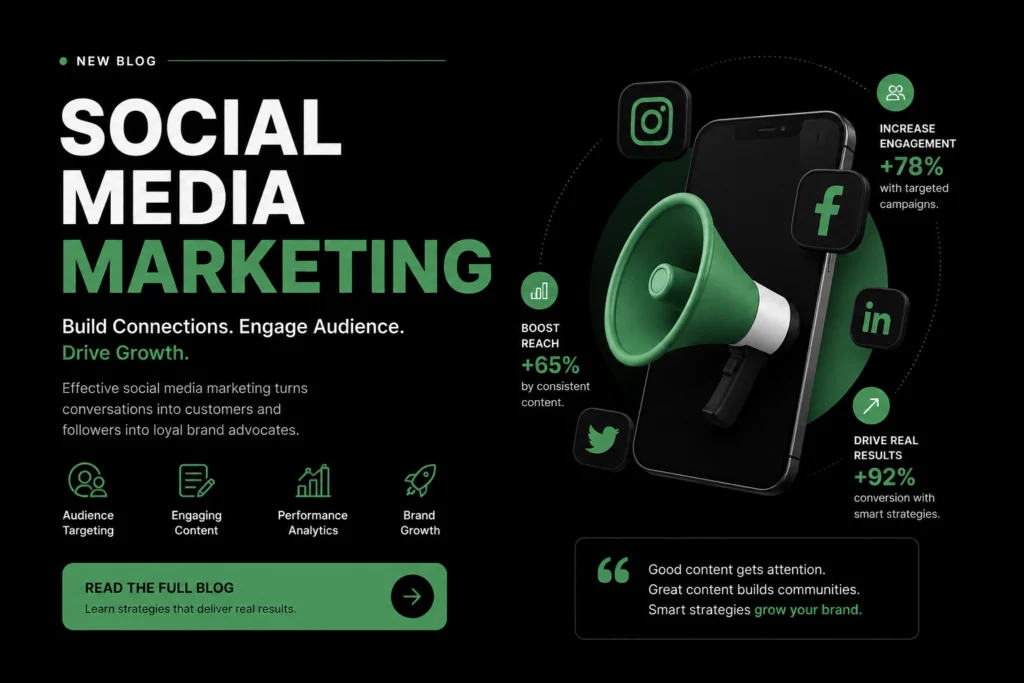
Social media marketing (SMM) refers to the wide range of marketing activities and approaches aimed to promote one’s brand and business using social media networks and engagement.
There are numerous examples of these platforms, including Facebook, Instagram, LinkedIn, X (Twitter), TikTok, and YouTube.
Each of these resources is different in terms of the given audience, purpose, and available marketing tools.
Therefore, it is critical to understand what each platform offers and adjust the content accordingly.
The Importance of Social Media Marketing (SMM)
Today, customers spend hours and hours every single day on social media.
Therefore, it has become necessary for businesses to follow these trends and use social media marketing to find and engage with their target clients.
As a relatively new concept, social media facilitates two-way communication between the customers and the brand.
It also allows businesses to build brand image, increase awareness, generate sales leads, and assist in other marketing and business objectives.
Below are some of the benefits that come with this:
• Brand awareness growth
• Increased website traffic
• Greater customer engagement
• More sales lead generations
• Affordable and cost-effective marketing
• Enhanced business relationships
• Higher conversion rates
Therefore, businesses that maintain consistent social media activity are much more likely to achieve their marketing and business goals and increase their conversion rates.
Key Elements of a Successful Social Media Strategy
There is no doubt that social media has become one of the most effective marketing tools of recent decades.
However, developing a successful social media strategy might seem like a challenging endeavor.
1. Define Goals and Objectives
All businesses must begin with defining their purpose and the specific goals they wish to achieve using social media marketing.
For instance, one might want to increase brand awareness or generate more leads for one’s product or service.
It is vital to have a list of attainable yet challenging objectives to measure one’s progress and know when the marketing strategy has succeeded.
2. Define and Understand Your Audience
The next critical step is to define and understand the target audience. The more information one has about the desired clients, the easier it will be to create content that resonates with them.
It is essential to pay attention to their interests, values, and pain points and understand who they are (age, gender, location, job, etc.).
3. Develop and Share Useful Content
When it comes to social media marketing, quality content is king.
There is no magic formula or pattern, but most successful companies create content that helps their target clients solve some pressing issues or at least provides food for thought.
One might use videos, reels, educational content, product reviews, carousel, and numerous other tools to share useful information with one’s followers.
4. Be Consistent and Follow Certain Rules
Consistency is crucial for social media marketing success.
Most businesses fail in their attempts at social media marketing because of their irregular publishing schedule or sheer lack of persistence.
To increase one’s chances of succeeding, it is vital to maintain a consistent social media presence and publish regularly.
Moreover, creating a content calendar and having a good social media strategy in place can help tremendously.
The Role of Video Content in Social Media Marketing
In recent years, video content has become one of the most powerful tools in social media marketing.
Moreover, it appears to be the most in-demand content by social media users.
This pattern is evident in one’s ability to successfully target specific audiences based on a variety of factors, including age, location, and interests. Moreover, using an effective mix of hashtags and keywords can also improve the chances of getting the posts seen by the target audiences.
Therefore, regular publishing is highly encouraged, although it is vital to maintain consistency and be authentic to one’s brand image.
Why Social Media Advertising is Important
While many businesses refrain from using paid means to post on social media, advertising is one of the easiest and most cost-effective methods to boost one’s content.
Social media advertising can be very beneficial for businesses that know what they are looking for.
Primarily, paid content appears in searches of those uninterested in one’s brand, thus presenting an excellent opportunity to target specific audiences and spread information about one’s product or service.
Some advertisers might find it challenging to identify the characteristics of the target audiences. Nonetheless, the characteristics include age, gender, location, interests, job positions, and even the ability to pay.
What to Avoid when Managing Social Media Accounts
While there are undoubtedly numerous best practices for social media marketing success, some important mistakes should be avoided at all costs.
The first crucial mistake is the irregular publishing schedule, which indicates a lack of commitment and interest. Second, companies should avoid using social media as a purely promotional tool. Instead, it should be used to provide value to the target audiences.
Other common mistakes include the failure to analyze the social media data, poor visuals, and copying others’ content or marketing strategies.
What arethe Most Important SMM Success Metrics?
Businesses that wish to measure the success and effectiveness of their social media marketing activities should track several key performance indicators (KPIs). They include brand awareness growth, impressions, reach, engagements, follower growth, sales, clicks, and other important metrics. In addition, companies should track their earned impressions and shares, and the effectiveness of their ad campaigns and budget utilization.
Social Media Marketing Trends to Watch Out For
The field of marketing is constantly changing, and social media is not an exception.
As a result, organizations and businesses must stay aware of the latest trends and be able to utilize them for their advantage.
Some of the current trends in social media marketing include artificial intelligence (AI), personalized experiences for every client, user-generated content (UGC), influencer marketing, and social selling, among others.
Frequently Asked Questions About Social Media Marketing
Q: What is social media marketing (SMM)?
A: Social media marketing (SMM) is the umbrella term for a variety of marketing activities and tools aimed to promote one’s business using social media.
Q: Why is social media marketing important for businesses?
A: Social media marketing helps organizations achieve their marketing and business goals, including brand awareness growth, reaching one’s target audience, generating new sales leads, increasing website traffic, strengthening business relationships, and improving the conversion rates.
Q: How do I know which social media platform is the best for my business?
A: Choosing the best platform for one’s business depends on the target audience, the nature of one’s business, the marketing objectives, and the type of content that will be shared.
Q: How frequently should a business post on social media?
A: Companies should attempt to keep a consistent publishing schedule and post regularly on social media to increase their visibility in front of the target audiences.
Q: Does it make sense for businesses to advertise on social media?
A: Yes, it does. Businesses can advertise on social media by targeting specific audiences based on several different factors.
Conclusion
Social media marketing plays a crucial role in the success of most businesses today.
As previously discussed, it helps organizations meet different marketing and business objectives, ranging from brand awareness growth to cost-effective lead generation and sales growth.
However, to effectively utilize the power of social media marketing, one must understand the nuances of a successful strategy, be able to avoid common pitfalls, know the latest trends, and apply them correctly.
As a result, brands that employ successful social media marketing strategies are more likely to achieve their goals and grow their business faster.